Our path of commitment to the environment
The 10,000 people who work with us are the real engine of success.
Every choice in the Amadori Group begins with respect for each of them: from safety protection to overall well-being to the opportunity to grow professionally and contribute personally to the life of the company.
Our focus is also on valuing diversity, in all its forms: age, gender, social and cultural background. It is this interweaving of stories and skills that gives us energy and vision.
Truly listening to people-their needs, ideas, aspirations-allows us to evolve as a community and as a Group.
Truly listening to people-their needs, ideas, aspirations-allows us to evolve as a community and as a Group.
Amadori Group's commitment in numbers
Feed | The use of alternative raw materials.
1.106.246
Tons of raw materials acquired in 2024 for feed production
-0.4% compared to 2023
-0.4% compared to 2023
68%
cereals-increased use of derivatives from cereal by-products (Flour, Flour and Bran) in the baking industry (cookies) and pasta production
Renewable energy consumption
89.247
MWh electricity purchased from renewable sources in 2024
+72%
compared to 2023
Emissions
3.061.930
tons of CO2eq, emissions in 2024 (market-based)
Water consumption | More water reused
1.525.401
m3 total water consumption
787.734
m3 reused, out of a total of 4,480,109 m3
of total withdrawals
of total withdrawals
Packaging | Optimization and recycling
6-7
Tons of packaging material savings by reducing film weight
60%
Use of recycled PET, increasing to 70-100% where possible
Use of monomaterial films to replace multimaterial films
Use of monomaterial films to replace multimaterial films
Waste management | Recovery and circularity
112
tons total hazardous waste generated in 2023 | -9% compared to 2022
39.175
Tons | non-hazardous waste for recovery in 2023 | +15% from 2022
76
Tons | hazardous waste destined for recovery in 2023 | +38% from 2022
Recovery of animal by-products (ABP) for the production of:
- meal used as pet food
- poultry oil used for pet food, aquaculture and as biofuel
- organic soil improver or biomass fuel
Decarbonization and climate change
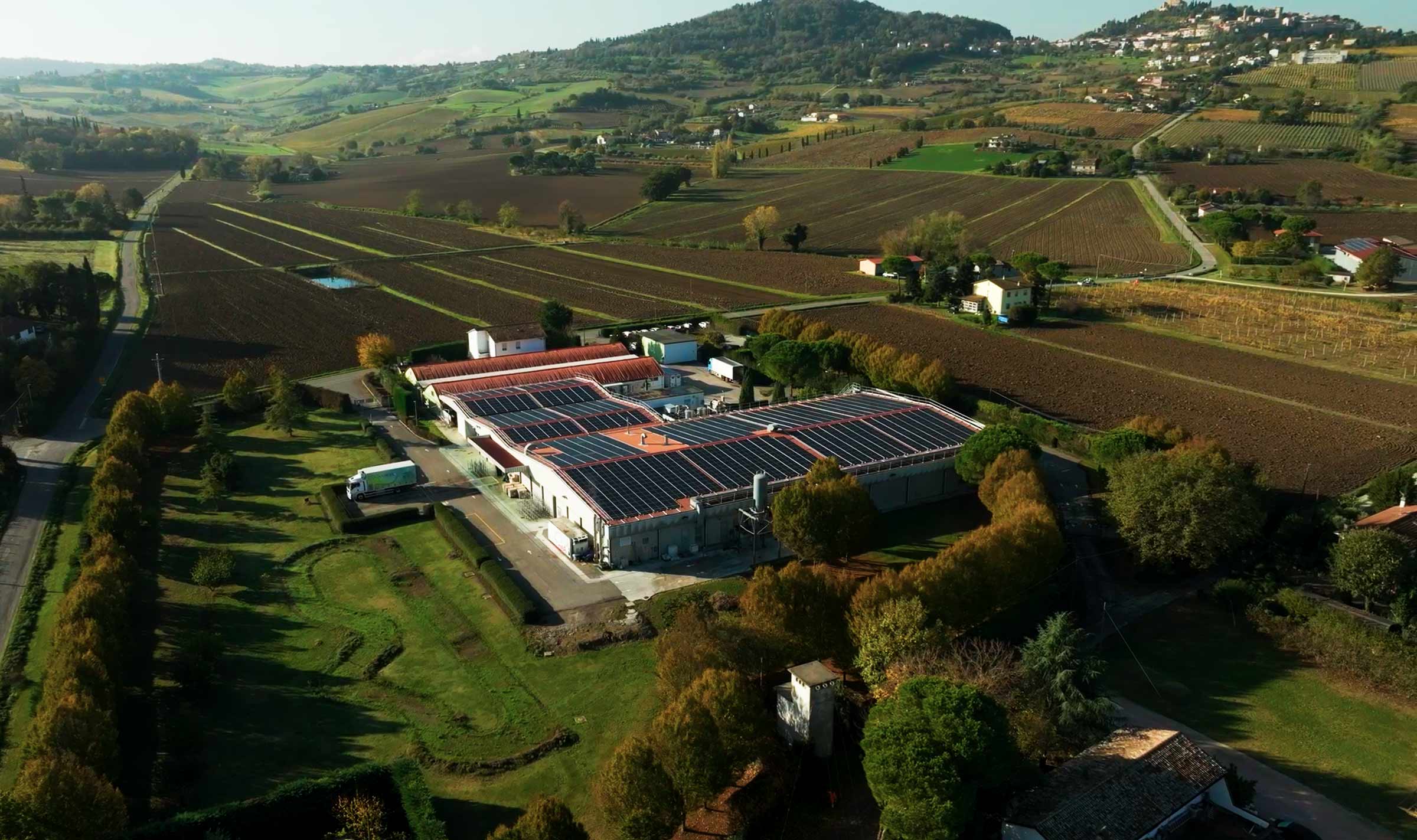
We reduce consumption and emissions by investing in increasingly efficient energy solutions and renewable sources. Periodic monitoring of greenhouse gases produced throughout the supply chain and SBTi-validated targets guide our decarbonization plan, which is periodically verified by independent third-party experts.
Responsible use of water resources
We support responsible water use throughout the supply chain and implement water treatment and recovery systems.
Circular Economy
We work to optimize the use of materials, encourage reuse solutions and contain waste along the supply chain.
Certifications and compliance with environmental regulations
The Amadori Group's commitment to environmental sustainability is confirmed by the international certifications obtained for its production areas.
4
Food processing plants certified to the ISO 14001:2015 standard for environmental management
2
Food processing plants follow the ISO 50001:2018 standard for energy management, with the inclusion of the Mosciano Sant'Angelo (TE) plant
Our attention is not limited to certifications: all our facilities comply with environmental regulations through Integrated Environmental Authorizations (AIA) or Single Environmental Authorizations (AUA), depending on the type and capacity of production sites.
This choice allows us to manage food processing stages but also feed mills, hatcheries, and farms with high standards of environmental protection, in terms of energy consumption, waste management, water footprint, and emissions.
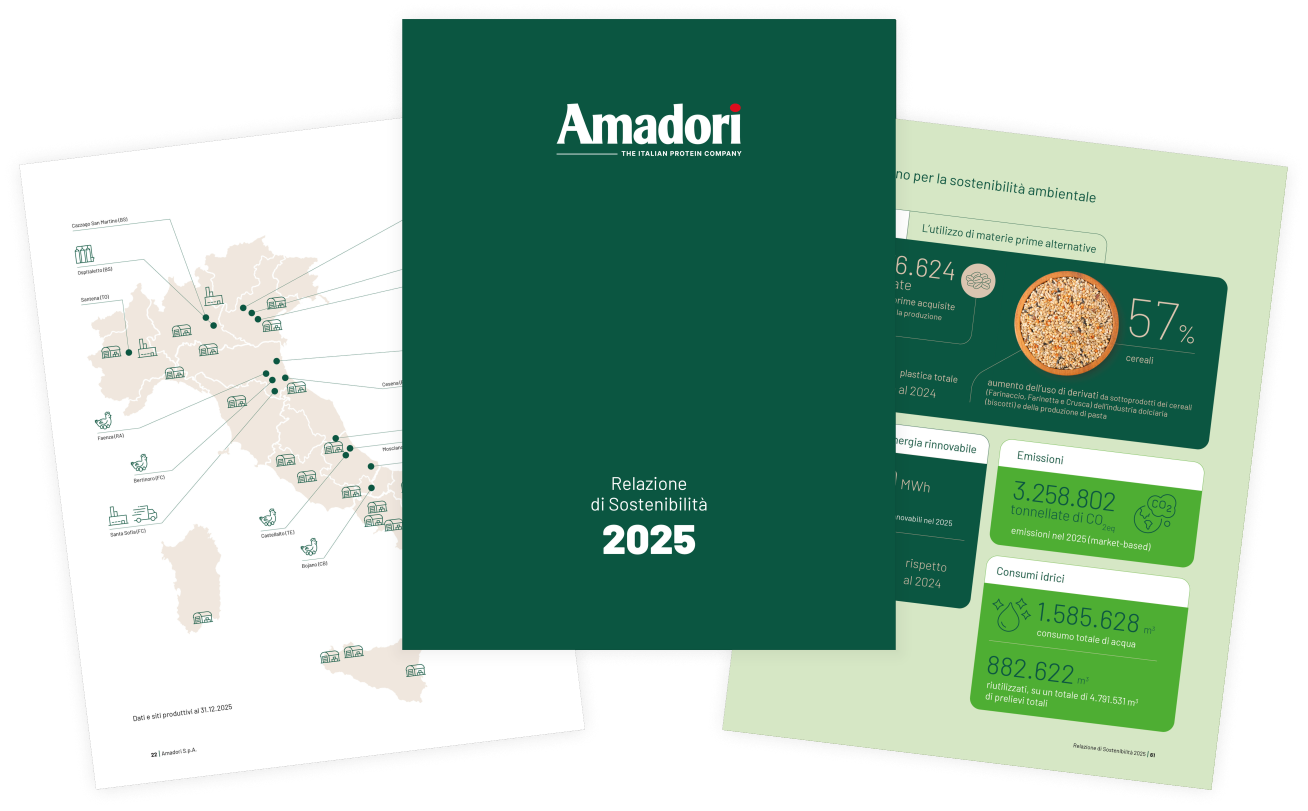
Learn more about our environmental commitment
Our sustainability journey is made up of concrete actions, measurable results and responsible choices throughout the supply chain. To learn more, you can view our Sustainability Report and discover in detail the progress and goals that drive our efforts.